

Bringing Premium, Non-Laser, Reversible Vision Correction and Leading EVO® ICL™ Expertise to Colorado’s Front Range Patients.
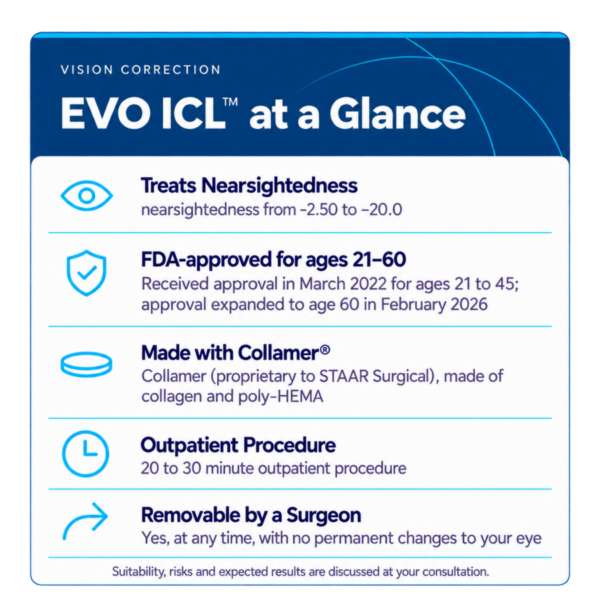
The EVO ICL (Implantable Collamer Lens) is an FDA-approved, flexible lens implant that corrects nearsightedness with and without astigmatism—helping you see clearly at a distance with less reliance on glasses or contacts.
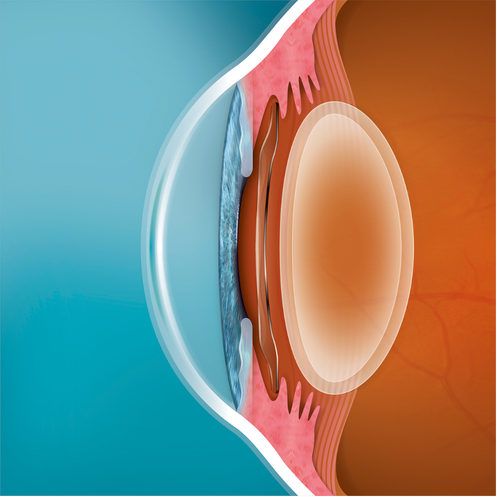
Made from a biocompatible material called Collamer®, the lens is placed between your iris and your eye’s natural lens.
EVO ICL works with your natural lens to correct your vision, without removing it or reshaping your cornea.
Innovative, Lens-Based Solution
The biocompatible EVO ICL implant delivers sharp and long-lasting clarity with built-in UV protection.
Reversible for Peace of Mind
Designed for permanent vision correction but removable by an eye doctor at any time — with no changes to your eye’s structure.
Personalized Treatment, Optimal Outcomes
Lens sizing and treatment are tailored to your prescription, eye anatomy, overall eye health, and lifestyle, using the latest advanced imaging.
The EVO ICL is designed to remain in place with no maintenance required as long as you are satisfied with your vision. Because of its placement, only you and your eye doctor will know it’s there; it won’t be visible to others. An eye doctor can remove the lens(es) at any time, such as if your vision changes significantly or if you’d like to upgrade to a different vision correction procedure.
✓ When you choose ICON Eyecare in Denver, you can feel confident knowing your vision is in the hands of experienced, board-certified surgeons who specialize in the full range of modern vision correction.
✓ We’re more than just a LASIK center; we’re a comprehensive ophthalmology practice with multiple convenient locations across the Front Range, offering advanced vision correction in a medical setting designed for your safety, optimal outcomes, and long-term eye health.
✓ Our surgeons are leaders in their field, with advanced fellowship training, publications in respected medical journals, and national recognition, including being named among 5280 Magazine’s Top Ophthalmology Doctors.

What a great experience! I recently had ICL surgery performed by Dr. Kim, and the experience was amazing.
Dr. Kim completed my ICL procedure, and I couldn’t be happier! I woke up the day after my procedure and have 20/20 vision! I am so happy Dr. Kim did my ICL!
I had ICL surgery, and it was the best choice I have ever made. For the first time in my life, I can see clearly without having to put contacts in or wear glasses.
ICON Eyecare is proud to have three EVO ICL-certified eye surgeons on our team. Dr. Eva Kim is one of the first surgeons in the United States to earn EVO ICL certification and has extensive experience in lens-based and corneal vision correction. She’s joined by Dr. Menachem Weiss and Dr. James Tian, both board-certified ophthalmologists and fellowship-trained surgeons with expertise in cornea, cataract, and refractive surgery.

Eve Kim, M.D.
Ophthalmologist
Cataract and Refractive Surgeon, Uveitis Specialist
Vice President of Operations and Medical Director, Front Range Colorado

Menachem Weiss, M.D.
Ophthalmologist
Cataract and Refractive Surgeon, Corneal Specialist
You may be an ideal candidate if:
EVO ICL is a highly effective vision correction solution, but it’s not right for everyone. Patients who are pregnant or nursing, have farsightedness, have other eye conditions like glaucoma or cataracts, or don’t have the right eye shape or measurements should talk to our eye care team about options that may be better suited for them.


Your EVO ICL experience at ICON Eyecare begins with a detailed evaluation and continues through your procedure, recovery, and follow-up care. While
every patient’s journey is different, our team will guide you through each step so you know what to expect and feel confident in your care.
Your EVO ICL experience at ICON Eyecare begins with a detailed evaluation and continues through your procedure, recovery, and follow-up care. While every patient’s journey is different, our team will guide you through each step so you know what to expect and feel confident in your care.
If you and your eye surgeon determine that EVO ICL is the right choice for you, you will be scheduled for a detailed preoperative evaluation. Our team will assess your prescription, eye health, and internal eye anatomy using advanced diagnostic technology. We’ll take detailed measurements of your eye’s corneal thickness, pupil size, and internal depth and shape to help your surgeon select the appropriate ICL size and develop a surgical plan tailored to your eyes.
During this appointment, we will also review applicable pre-op instructions and provide necessary prescriptions for antibiotic and anti-inflammatory eye drops for after the procedure.
At ICON Eyecare, our eye surgeons use the Sonomed Escalon VuMAX HD ultrasound biomicroscope with UBM AI technology to capture high-resolution images and detailed eye measurements. This advanced imaging methodology supports individualized ICL sizing and surgical planning, helping tailor each EVO ICL™ treatment plan to the patient’s unique eye anatomy.
Your EVO ICL procedure will take place at either our Madison Street Surgery Center or our Lone Tree Surgery Center. Although the surgery typically lasts only 20-30 minutes, you should plan to spend additional time at the surgery center for preparation, monitoring, and recovery.
Once you arrive, your eye doctor will administer numbing eye drops and dilate your pupils. You may also receive other medication to help you relax. After the procedure, our team will take you to a recovery room, where you will be monitored for a short time before being allowed to go home.
Be sure to arrange transportation and bring dark sunglasses — you won’t be able to drive after surgery due to light sensitivity and drowsiness from medication.
Most patients notice improved vision immediately after surgery, although temporary blurry or hazy vision is normal. Typically, patients can resume normal daily activities, like driving or returning to work or school, within one to two days.
Our eye care team will schedule follow-up appointments for 3-4 hours after surgery, one day post-op, one week post-op, and one month post-op. These appointments help monitor your healing and ensure your vision is stabilizing, so it’s important to attend each one. Most patients will continue to see improvements in their vision, but full recovery can take one to three months. After EVO ICL, patients should also continue to schedule annual eye exams with their primary eye care provider.
EVO ICL is FDA-approved and considered a safe, effective vision correction surgery, with 95% of treated eyes achieving 20/20 vision or better and 99% achieving 20/25 vision or better. Like all medical procedures, it carries some potential risks and side effects, which can include:
More serious complications are rare but can include cataract formation and increased intraocular pressure. Your eye surgeon will monitor your eye health carefully and recommend treatment as needed, including removal or replacement of the ICL.
Contact us immediately if you experience any pain or lasting discomfort during your recovery.

The EVO ICL is made of a unique material called Collamer, which is proprietary to STAAR Surgical. Collamer is a copolymer that contains a small amount of purified collagen, making it biocompatible with your natural eye. The rest of the lens is composed of poly-HEMA (a material used in traditional soft contact lenses), water, and a UV-absorbing agent for built-in protection from UV rays.
EVO ICL corrects nearsightedness with or without astigmatism by implanting a flexible, biocompatible lens between the eye’s iris and natural lens, while LASIK corrects nearsightedness, farsightedness, or astigmatism by using a laser to remove tissue and reshape the cornea
Many patients choose EVO ICL for its non-laser approach and reversibility. Unlike LASIK, EVO ICL corrects your vision without permanently reshaping the cornea, and an eye doctor can remove the lens at any time. It is often an option for patients who don’t qualify for LASIK due to thin corneas, dry eyes, or higher levels of nearsightedness.
Ideal EVO ICL candidates are between 21 and 60 years old, have moderate to high nearsightedness with or without astigmatism, have dry eyes or thin corneas, and have a stable vision prescription.
Although EVO ICL is designed for permanent vision correction, an eye doctor can remove the lens(es) at any time.
Most patients report a painless experience because the eye surgeon uses numbing eye drops before the procedure. Mild, temporary discomfort is normal as the numbing drops wear off.
Most patients notice improved vision immediately after surgery and can return to work or school within one to two days. Vision can continue to stabilize over one to three months.
Once the EVO ICL is placed in its fixed position, it will not move around, and you won’t be able to feel it. Its flexible, biocompatible material works with your eye, so your eye does not treat it as a foreign object.
The lens sits between the iris (the colored part of your eye) and your eye’s natural lens, so it’s not visible to others once it’s in place.
Most people do not need glasses after EVO ICL because it’s designed to reduce reliance on corrective lenses to see objects clearly far away. However, EVO ICL does not prevent age-related vision changes that occur naturally (presbyopia), so you may need reading glasses as you age. The EVO ICL can be removed at any time, including if you choose to upgrade to a refractive vision correction procedure that can correct presbyopia, like clear lens exchange.
The cost of EVO ICL surgery can vary depending on several factors, but it typically ranges from $3,500 to $5,000 per eye.
EVO ICL is generally considered an elective procedure and is most often not covered by insurance. However, we offer several payment and financing options to make this more affordable and accessible for more patients.
 Refer a Patient
 Pay Bill
 Patient Portal