ICL surgery is a lens-based refractive surgery alternative that corrects poor vision by introducing an intraocular lens to the eye instead of altering the shape of the cornea, as with LASIK surgery or Photorefactive Keratectomy (PRK).
An Implantable Collamer Lens, like EVO ICL™ is essentially a contact lens that is implanted in the eye. It is an artificial lens that works in harmony with your eye to correct your vision. The lens is implanted into the eye, right behind the iris, during a 20-30 minute procedure. EVO ICL™ is a great vision correction choice for patients with thin corneas or dry eye and who have moderate to severe nearsightedness (-2.50 to -20.0), with or without astigmatism.
The EVO® ICL™ (Implantable Collamer Lens) is an advanced soft-material lens, slightly smaller than a typical contact lens. It provides UV protection and permanent vision correction while giving patients a quality of vision that is sharper and clearer than can be achieved with glasses or contacts.
The EVO® ICL™ is meant to remain in place as long as you are satisfied with your vision. A doctor can remove the lenses without compromising your vision, if your vision changes or you’d simply like to remove them.
Hear Ashley’s story of ICL surgery with ICON Eyecare.
EVO ICL™ may be an excellent vision correction option for eligible patients with nearsightedness, with or without astigmatism. If your surgeon determines that EVO ICL™ is appropriate for your eyes and vision goals, you will be scheduled for a detailed preoperative evaluation. During this appointment, the ICON Eyecare team will assess your prescription, eye health, and internal eye anatomy using advanced diagnostic technology. These precise measurements help your surgeon select the appropriate ICL size and develop a surgical plan tailored to your eyes.
EVO ICL™ surgery is a minimally invasive outpatient procedure. When medically appropriate, both eyes may be treated on the same day. The procedure itself is typically brief, although you should plan to spend additional time at the surgery center for preparation, monitoring, and recovery. Many patients notice an improvement in their vision soon after surgery and can return to several routine activities within a few days. Healing and visual stabilization vary, so it is important to follow your surgeon’s postoperative instructions and attend all scheduled follow-up appointments.
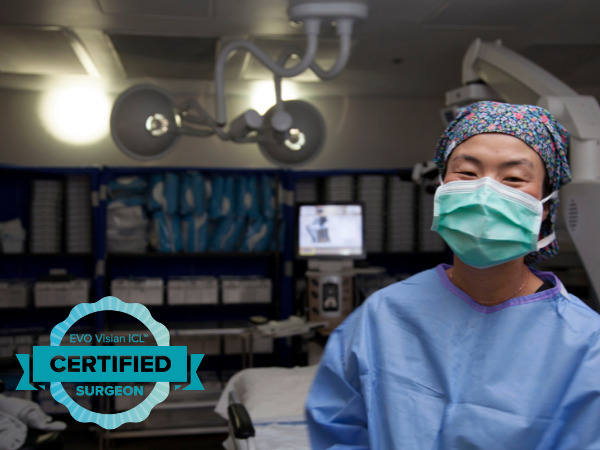
Dr. Eva Kim, ICON Eyecare’s Front Range Medical Director, is one of the first surgeons in the United States to earn EVO ICL™ certification and has extensive experience in lens-based and corneal vision correction. She uses the Sonomed Escalon VuMAX HD ultrasound biomicroscope with UBM AI technology to obtain high-resolution images and detailed measurements of the eye. She applies this advanced imaging methodology to support individualized ICL sizing and surgical planning, helping tailor each EVO ICL™ treatment plan to the patient’s unique eye anatomy.
Dr. Kim is joined by Dr. Menachem Weiss and Dr. James Tian, both board-certified ophthalmologists and fellowship-trained surgeons with expertise in cornea, cataract, and refractive surgery. Together, ICON Eyecare’s EVO ICL™ surgeons provide personalized treatment recommendations based on each patient’s prescription, eye anatomy, overall eye health, and lifestyle.

ICON Eyecare is proud to utilize the Sonomed Escalon VuMAX HD Ophthalmic Ultrasound, a high-resolution diagnostic tool used to capture detailed images and precise measurements of the eye’s internal structures. At ICON Eyecare, we utilize this advanced technology to assist in the accurate sizing and placement of the Implantable Collamer Lens (ICL). By providing high-definition imaging of the anterior and posterior segments, the VuMAX HD helps ensure optimal outcomes and personalized treatment for patients seeking long-term vision correction.
What a great experience! I recently had ICL surgery performed by Dr. Kim and the experience was amazing.
Dr. Kim completed my ICL procedure and I couldn’t be happier! I woke up the day after my procedure and have 20/20 vision! I am so happy Dr. Kim did my ICL!
I had ICL surgery and it was the best choice I have ever made. For the first time in my life, I can see clearly without having to put contacts in or wear glasses.
The EVO ICL procedure is about 20 to 30 minutes total. To prepare for the eye surgery, you will be given eye drops and other medications. Once in surgery, your surgeon will create a small opening for lens implantation. The lens is carefully folded and inserted through that small incision opening. Your surgeon will then carefully position the lens based on your eye’s anatomy. Simple as that!
The cost of ICL surgery can vary depending on several factors, but it typically ranges from $3,500 to $5,000 per eye.
Vision correction with the EVO ICL™ is an outpatient procedure that typically takes 20 to 30 minutes. After an initial exam with your ophthalmologist to determine that the EVO ICL™ is right for you, you will schedule your procedure. On the day of the procedure, your eyes will be numbed with an anesthetic eye drop, and your refractive surgeon will implant the ICL between the iris (colored part of the eye) and the natural lens. Your surgeon will likely schedule a follow-up appointment the same day as the procedure.
No, patients should not feel the lens as it does not adhere to any structures within the eye and does not move once in place.
No, the EVO lens is placed behind your iris where only your eye doctor will be able to detect it.
ICL is essentially a contact lens implanted in the eye, whereas LASIK surgery uses lasers to reshape the cornea.
Ideal candidates are typically between the ages of 21-45 with a stable vision prescription. Talk to your eye care doctor to determine if you are a good candidate for Implantable Collamer Lens (ICL) surgery.
 Refer a Patient
 Pay Bill
 Patient Portal